A potential customer found your business on Google last Tuesday. They clicked your website, waited eight seconds for it to load, saw a wall of text above a stock photo of a handshake, and hit the back button. They called your competitor instead.
You'll never know that happened. No angry email, no phone call explaining why they left. They just didn't choose you — and your analytics registered it as a "bounce," which you probably don't check anyway.
This happens hundreds of times a year for most small businesses. The frustrating part is that the fixes are almost never complicated. They're the same five things, showing up on almost every site we audit.
1. Your headline doesn't say what you actually do
Open your website right now and look at the first line of text. Does it tell a stranger — in plain language — exactly what you do and where you do it?
Most business websites fail this test immediately. They lead with something like "Welcome to Johnson's" or "Quality service you can trust" or, my personal favorite, "Your success is our mission." None of those tell me anything. None of them make me feel like I'm in the right place.
A headline that works sounds more like: "Emergency plumbing in Denver — available 24/7" or "Custom cabinets for Denver homeowners, built to last." Boring? Maybe. But it answers the one question every visitor is silently asking: Is this the right place for me?
Rewrite your headline using this formula: [What you do] + [Who you serve] + [Your differentiator or location]. Don't be clever. Be clear.
The mistake most people make is writing their homepage headline for their existing customers — people who already know who they are. Your homepage needs to work for the person who has never heard of you and landed there from a Google search. That's most of your traffic.
2. There's no obvious next step
Imagine walking into a store, looking around for 30 seconds, and then having a salesperson vanish when you wanted to ask a question. That's what a website without a clear call to action feels like.
The problem usually isn't that there's no call to action — it's that there are too many, or the most important one isn't visually dominant. A lot of sites have a "Contact Us" link buried in the nav, a phone number in the footer, and a form somewhere in the middle. None of them feel urgent. None of them stand out.
Visitors shouldn't have to figure out what you want them to do. You should tell them, clearly and repeatedly. One primary action — call this number, book this appointment, request this quote — should be visible without scrolling on both desktop and mobile.
For service businesses, the phone number is usually the most important conversion point. Make it a tappable link (tel: format) so mobile visitors can call with one tap. Then put it in your header, in the middle of the page, and in the footer. That's not excessive — that's helpful.
3. You have no social proof above the fold
People trust other people more than they trust businesses. This is not news. It's why Yelp exists, why Amazon reviews drive purchase decisions, and why a word-of-mouth referral converts at three times the rate of a cold website visit.
The problem is most business websites bury their proof. Reviews are on a separate "/testimonials" page that almost nobody visits. Star ratings are missing entirely. There's no mention of how many customers you've served, how long you've been operating, or any logos of publications or organizations that have vouched for you.
Your visitor is deciding whether to trust you, and they're doing it fast. Give them reasons to trust you that don't require clicking to another page.
"A single visible five-star review near your main call-to-action will do more for your conversion rate than a full page redesign."
What works: three or four real Google review excerpts on your homepage, a star rating count ("★ 4.9 — 140 reviews on Google"), and any relevant badges or certifications. If you've been in business for 20 years, say so prominently. If you've served 1,000 customers, say that too. These numbers matter to people who don't know you yet.
4. Your site isn't built for mobile — it's just visible on mobile
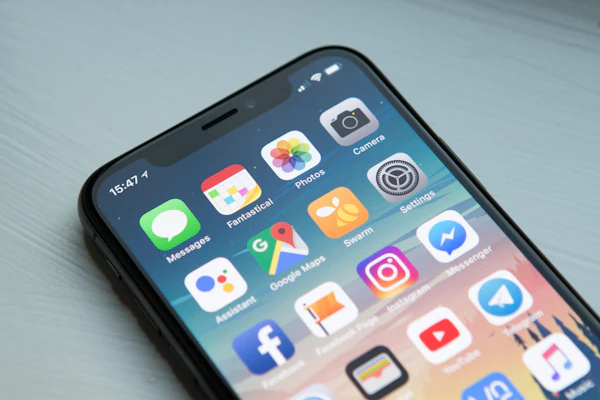
There's a difference between a site that technically loads on a phone and a site that's actually designed for someone using a phone. The first is a technical minimum. The second is how you get customers from the 63% of your visitors who are on mobile devices.
A site that's "visible" on mobile often has: a phone number that's a static image (not tappable), a contact form with tiny fields that require zooming, a navigation menu that covers the whole screen when opened, and text that's readable only if you tilt your phone sideways.
A site that's built for mobile has: a tap-to-call button that's impossible to miss, a form with large input fields, a clean hamburger menu, and typography that's comfortable to read at arm's length on a 6-inch screen.
Google uses mobile performance as a primary ranking factor. A site that's slow or awkward on phones doesn't just lose customers — it ranks lower in search results, meaning fewer people find you in the first place.
The test: hand your phone to someone who has never visited your site and ask them to find your phone number and call you. If they struggle, you have a mobile problem.
5. The page loads slowly
We'll cover this in a lot more depth in a dedicated post on page speed, but the short version is this: if your site takes more than three seconds to load on a phone with average cell service, you're losing roughly half your mobile visitors before they've seen a single word you've written.
The most common culprits: images that were uploaded at full resolution and never compressed, a WordPress install with 14 plugins running on shared hosting, and a theme that loads six different font families and a JavaScript framework to display three paragraphs of text.
Run your site through Google PageSpeed Insights (search for it, it's free). If your mobile score is below 60, this is your biggest problem. Honestly, it might be your biggest problem even if it's at 75.
Where to start
If you're looking at this list feeling overwhelmed, don't try to fix all five things at once. Prioritize in this order:
- Mobile speed — a slow site undermines everything else.
- Clear headline — tell visitors instantly they're in the right place.
- Visible CTA — make the next step obvious, especially on mobile.
- Social proof on the homepage — move reviews above the fold.
- Headline clarity — tighten the language on your main value proposition.
None of these require a full redesign. Most of them can be addressed by editing the content you already have and making a few layout adjustments. The difference in leads can be dramatic — we routinely see businesses go from two to three web-generated calls per week to ten or twelve after addressing the basics.
Not sure which of these is hurting you most?
We'll audit your site for free and tell you exactly what's costing you customers — no obligation, no sales pitch.
Get a free website audit