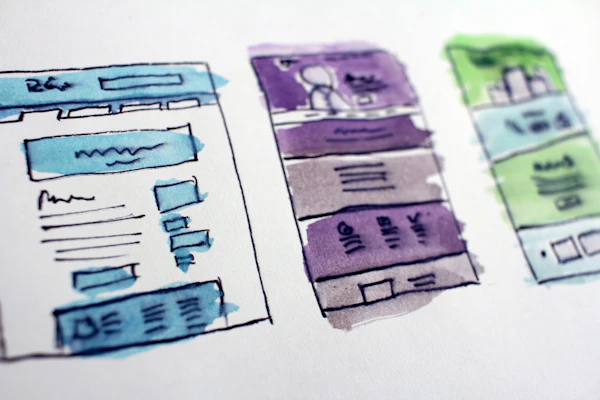
Most roofer websites look professional. They have nice photos, an about page, and a contact form. But a lot of them share a hidden problem: Google doesn't understand what they do or who they serve. They're invisible where it matters most — on the first page of local search results.
Across roofing websites we come across, the same seven critical mistakes show up again and again. These aren't design flaws. They're SEO mistakes that actively prevent a site from ranking. And the good news? They're all fixable.
The verdict: your website is built to look good, not to rank
The gap between a professional-looking roofing site and one that actually generates calls from Google is bigger than most roofers realize. A beautiful site with zero visibility is worthless. A plain site that ranks on page one and converts visitors into calls is worth thousands per month.
Here's the pattern: most roofer sites we look at don't have regional service-area pages, are missing proper Google Business Profile optimization, and load slowly on mobile — which is now a ranking factor Google won't overlook. The estimates below reflect that typical spread.
Mistake 1: No service-area pages
Most roofing websites serve Denver and the surrounding area. But their site reads like it serves everywhere and nowhere. When someone in Boulder searches "roof repair," Google has no reason to show your Denver-based site first.
The fix: build dedicated pages for each major service area. A page for "roof repair in Boulder," another for "roof replacement in Aurora," etc. Each page targets the specific city + service combination, gives local details (neighborhoods served, local testimonials, regional challenges), and tells Google exactly where you operate.
We see this constantly — the homepage mentions "Denver metro," but the site has zero pages targeting Boulder, Littleton, Westminster, or any other city. This is a massive missed opportunity. Each city page is a ranking opportunity that costs nothing to build but generates dozens of qualified leads annually.
Service-area pages don't cannibalize each other if you structure them correctly. Each page targets a unique city/service combo, so there's no ranking conflict. Google actually rewards sites that show deep local expertise across multiple regions.
Mistake 2: Missing schema markup
Schema markup is structured data that tells Google what your business is, where you are, what you do, and how to contact you. Without it, Google has to guess. With it, Google understands instantly and can show your info in rich search results.
A majority of roofer sites have zero schema. That means no star ratings in search results, no phone number visible next to your listing, no clear business category. You're competing against roofers who DO have this, and they look more trustworthy.
The fix: add LocalBusiness schema (minimum), then add Service schema for each roofing service you offer. A few lines of JSON-LD code embedded in your site header tells Google your company name, phone number, address, service areas, business hours, and customer ratings. The payoff is immediate visibility and higher click-through rates from search.
Mistake 3: Slow mobile page speed
Most roofing websites load slower than 4 seconds on mobile. At that speed, half your mobile traffic leaves before the page even loads. Google's own research shows that sites loading in 1–3 seconds have 70% lower bounce rates than sites loading in 6+ seconds.
And it's not just about user experience. Mobile page speed is a direct ranking factor. A slow site ranks below a fast site, all else equal. But here's the problem most roofer sites face: large hero images (beautiful photos of roofs and renovations), un-optimized image gallery, and extra JavaScript from contact-form plugins all add up to bloated pages.
The fix is straightforward: compress all images to web format (JPEG/WebP, not PNG), lazy-load images below the fold, minify CSS and JavaScript, and use a fast hosting provider. Most sites we optimize drop from 5–6 seconds to 2–3 seconds in a week. The result: more mobile visitors stay on the page, more complete the contact form, more calls.
Mistake 4: Thin and duplicate pages
We found roofer sites with five different pages all saying almost the exact same thing: the homepage, an "about" page, a "services" page, a "roofing services" page, and a "residential roofing" page. Same copy, slightly different layouts. Google sees this as duplicate content and ranks none of them well.
The other problem is thin pages — pages with so little unique content (100–150 words) that Google doesn't understand what they're about. A page that says "We offer roof repair. Call us." tells Google nothing. A page that explains what roof repair is, why it matters, what signs you need it, and how your process works tells Google plenty.
The fix: audit all pages, kill the duplicates, and expand thin pages to 400+ words of unique, valuable content. Each page should answer one specific question someone is asking (e.g., "How much does a new roof cost?") and have its own reason to exist. No page should say what another page already covers.
Mistake 5: No integration of Google Business Profile
Google Business Profile (GBP) is the single most important ranking factor for local searches. A site with a complete, up-to-date GBP profile ranks above sites without one. The large majority of roofer sites we come across have outdated or incomplete profiles.
The issues we see: phone number is old, business hours are wrong or missing, photos are from 2019, no customer reviews visible, description is generic template text. Some roofers have multiple GBP listings (accidental duplicates), which confuses Google and splits their ranking power.
The fix: claim your GBP, verify it's yours, update all business info (name, phone, hours, address, service areas), add 20+ high-quality photos (before/afters, team, projects), request reviews from past customers, and respond to all reviews. A complete GBP profile can push you from page 2 to page 1 in local search.
Mistake 6: No reviews or trust signals
Most roofer sites display zero customer reviews or ratings. Google and searchers both treat reviews as trust signals. A business with 50 five-star reviews ranks above one with zero reviews, all else equal.
But it's not just about rankings. When someone searches for a roofer in a snowstorm at 2 PM with a leaking roof, they call the business with reviews. They don't call the one with no social proof.
The fix: actively request reviews from past customers (via email, SMS, or a post-job follow-up call). Display those reviews on your site and in your GBP profile. Respond to every review, positive or negative. Most roofers ignore reviews. You can own your market just by showing up here.
Mistake 7: Weak calls-to-action
Roughly half of roofer sites bury their phone number or CTA below the fold, make it a tiny link instead of a big button, or use vague copy like "Contact Us." A visitor who wants to call has to hunt for your number. Some sites make it easier to find the form than the phone number, which is backwards for a service business.
The fix: make your phone number visible in the header on every page. Make it a clickable link on mobile so people tap to call. Use clear, action-driven copy: "Call for a free estimate," not "Contact us today." Put your biggest CTA button above the fold. The simpler you make it to take the next step, the more leads convert.
What to fix first
If you're overwhelmed by all seven mistakes, here's the priority order:
- Week 1: Update your Google Business Profile. This takes 1–2 hours and has the highest ROI. Verify it, update all info, add photos, request reviews.
- Week 2–3: Build 2–3 service-area pages. Target your biggest markets. Each page should be 500+ words and mention neighborhoods, local challenges, and past projects in that area.
- Week 4: Add schema markup. If you don't have a developer, this is when to hire one. A day of work pays off for months.
- Week 4–5: Fix mobile page speed. Test your site on mobile, compress images, lazy-load galleries. Most improvements don't cost money, just attention.
- Week 6+: Request reviews and strengthen CTAs. Do this ongoing. Each week, ask 2–3 past customers for a review. Move your phone number to the header.
The sites we see ranking on page one for "roof repair" have done all seven. The sites on page three have done maybe one or two. The gap is not a mystery — it's a checklist you can work through.
Want to know what your site needs?
RankLoft builds and ranks roofing websites. If you'd like a free SEO audit — what's working, what's broken, and what to fix first — get in touch.
Get a free audit →Frequently asked questions
How long does it take to fix these SEO mistakes?
Most fixes take 2–8 weeks depending on the scope. Schema markup and GBP optimization can go live in days. Service-area pages and blog content typically take 4–8 weeks. You should start seeing rank improvements in 60–90 days.
Will fixing these SEO issues directly lead to more calls?
Yes, but not overnight. Better rankings lead to more website visitors, and a properly optimized site converts those visitors into leads and calls. The full cycle—fixes → rank improvement → call increase—usually takes 90–120 days.
Do I need all 7 fixes, or can I start with a few?
Start with the highest-impact fixes first: GBP optimization, service-area pages, and mobile performance. Schema markup and review integration are second-tier but still important. Thin pages and weak CTAs can follow.
What's the difference between a good roofing website and one that actually ranks?
A good-looking site gets zero traffic if Google doesn't understand what you do or where you serve. Ranking sites are technically sound (fast, mobile-friendly), regionally targeted (service-area pages), trusted (reviews, schema), and clearly actionable (strong CTAs).
Can I fix these myself, or do I need a professional?
Some fixes (GBP, reviews, CTA clarity) you can do yourself. Others (schema markup, service-page strategy, performance optimization) are more technical. Most roofers save time hiring a specialist for the full audit → fix → verify cycle.
Sources
- Google Developers — Search Central Documentation
- Schema.org — LocalBusiness Schema Documentation
- BrightLocal — Local Search Ranking Factors Research
- Ahrefs Blog — SEO Best Practices and Case Studies
- Semrush Blog — Digital Marketing and SEO Research
- Google Business Profile Help Center
- Think with Google — Data-Driven Marketing Insights